Featured
Four systems, in active daily production use. Source code stays private where it touches real customer data — one of the four is fully public and linked below. What's shown for the rest is the architecture, the scale, and the specific engineering problems each one solved.
Team Gold — Cold-Calling CRM & AI Voice Platform
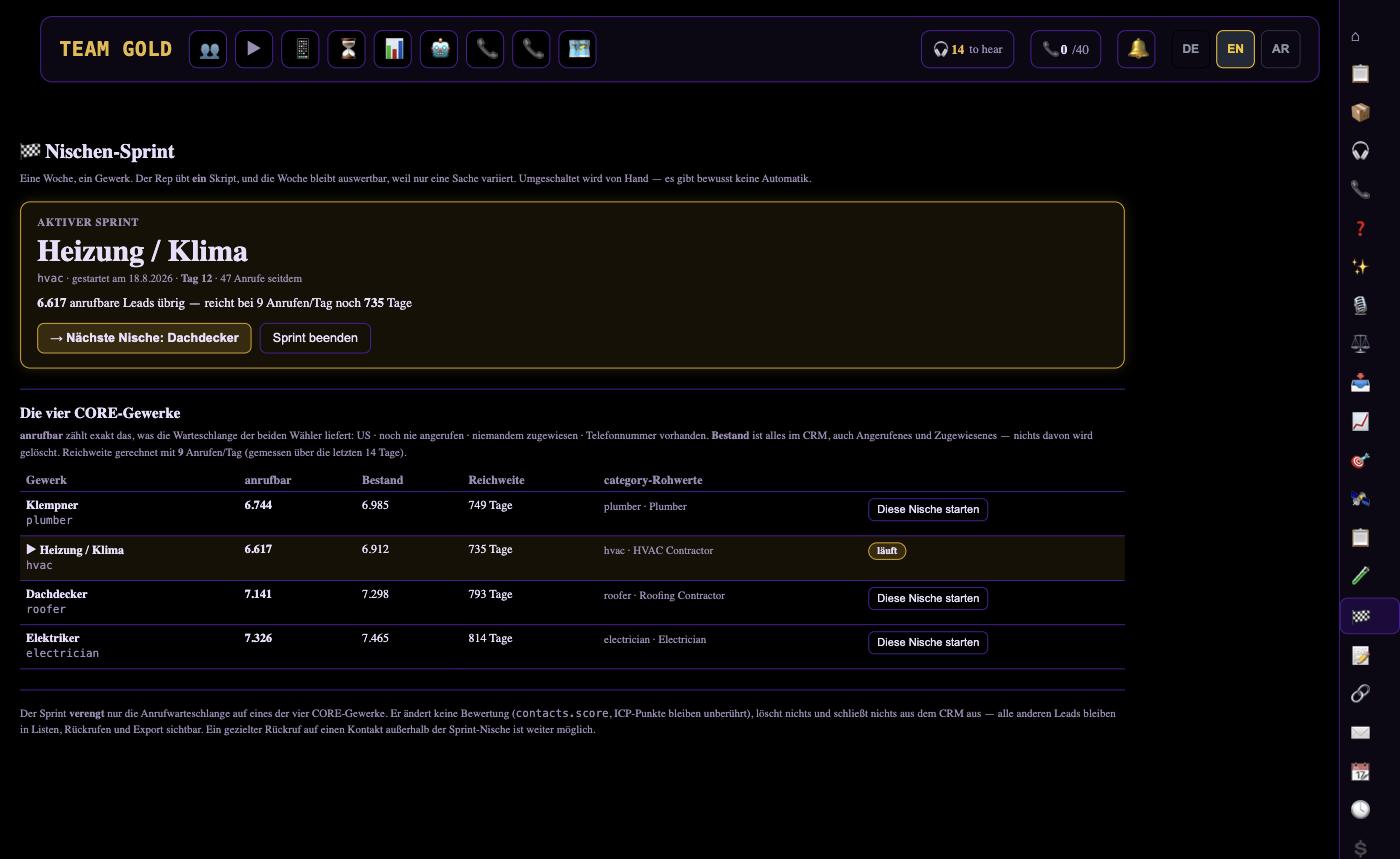
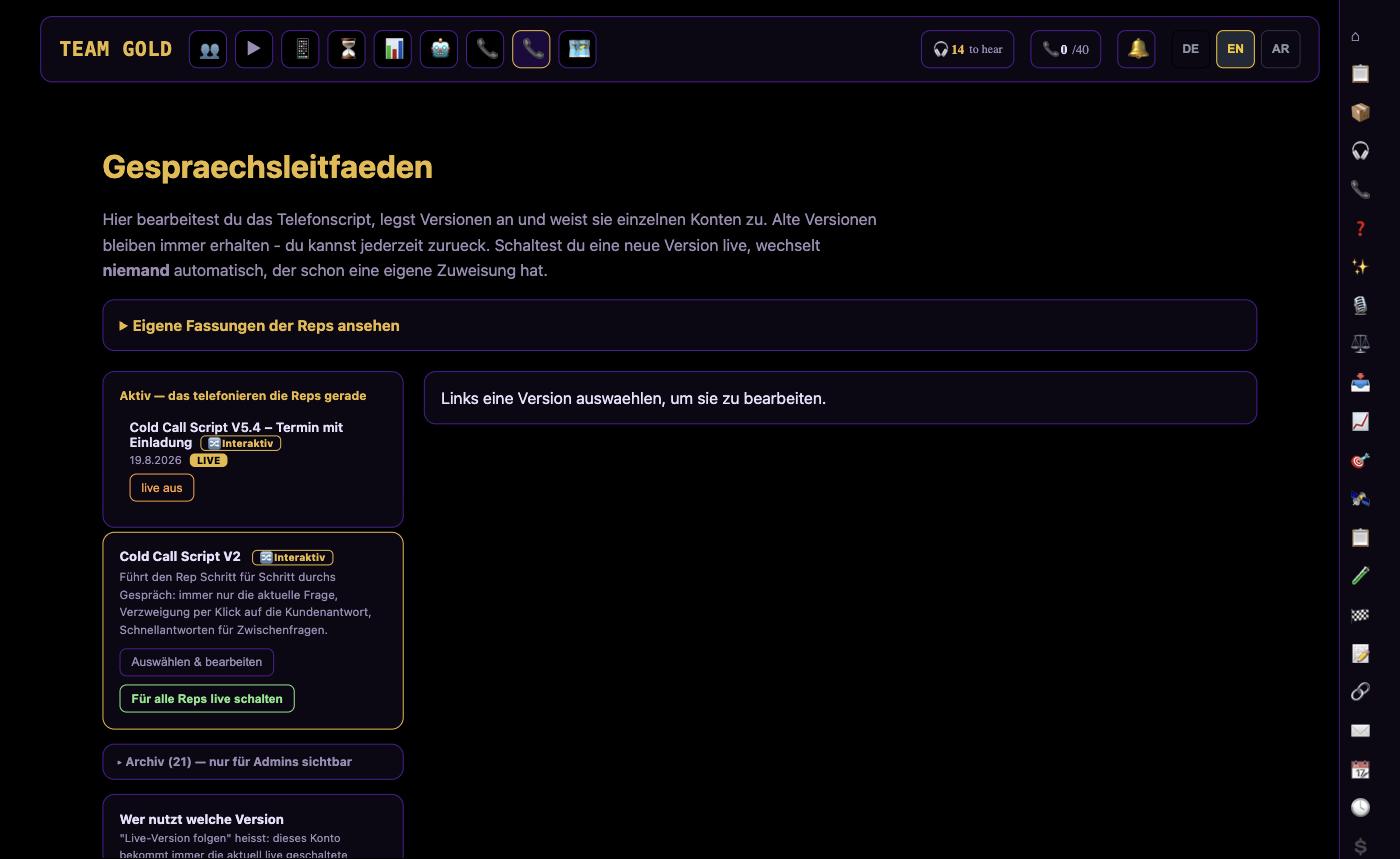
Sole builder & operatorA Next.js CRM built for a real cold-calling sales team: browser-based softphone dialing over WebRTC/Telnyx, an outbound AI voice agent that can run its own call shifts, live call recording and two-channel transcription, and a lead-scoring engine that decides who gets called next.
100k+leads scored & routed
7rotating outbound numbers, load-balanced
14+iterated call-script versions, A/B tested
Architecture
Next.js talks to Postgres through Supabase — row-level security policies enforce who can see which contacts at the database layer, not just in application code, so a bug in a page component can't leak another rep's leads. The call script itself is versioned rows in the database rather than code, so a wording change ships without a deploy.
Security & reliability
Every schema change ships with an explicit fallback path — a missing column degrades a feature instead of crashing the page. The outbound AI voice agent carries its own spend cap, a compliance-driven call-window check, and a kill switch that no single misconfigured toggle can override.
What made this hard
- Trustworthy scoring, not a vanity number. Lead priority combines need, budget, and reachability with a geometric mean instead of a raw product — a raw product looked fine in a spreadsheet but pushed almost the entire dataset into a handful of duplicate scores, which silently destroyed the ranking the dialer relied on.
- Call outcomes you can actually trust. Rep- entered call results turned out to be unreliable at scale, so every claimed outcome is now cross-checked against the one number a rep can't fake: measured call duration from the telephony provider itself.
- Two-channel audio, correctly attributed. AI call review needs to know who said what. Recordings are split into separate agent/customer channels before transcription — naive single-channel transcription let the model guess the speaker from content alone, which was wrong far more often than it looked.
- An AI agent with a hard leash. The outbound voice agent has its own budget cap, a compliance-driven call-window check, and a kill switch that a plain config change can't accidentally re-enable — the safety property that matters here is that "off" always means off, not "off unless five different code paths all agree."
Lead Generation Pipeline — Google Maps at Scale
Sole builder & operatorA always-on scraping and enrichment pipeline that finds local businesses, checks whether they still exist, reads their websites for real signals (hiring activity, ad spend, tech stack), and turns all of that into a single, explainable priority score — running continuously, watched by its own health checks.
24/7self-healing background process
2independent scrapers, cross-verified
30+extracted business signals per lead
Architecture
Two independently-built scrapers cross-verify each other's output before a lead is scored. Every long scan pages through the database by a stable cursor rather than a plain offset — offset pagination silently drops or duplicates rows the moment something else writes to the table mid-scan, which a one-off scan will never catch.
Security & reliability
A background watchdog restarts the scraper process, but only after confirming actual CPU activity over a time window — a crashed browser sub-process looks identical to a healthy one if you only check whether the PID still exists.
What made this hard
- "Still running" isn't a status you can assume. A crashed browser sub-process looked identical to a healthy one in the process list. The watchdog now checks actual CPU activity over a time window, not just whether the PID exists — the difference between those two once cost three days of silent downtime.
- Pagination under concurrent writes is a trap. Paging through a database with plain offsets while the table is being written to at the same time silently duplicates and skips rows — invisible until someone compares two "complete" scans and gets two different totals. Every long-running scan here pages by a stable cursor instead.
- A null is not a zero. "Never measured" and "measured and it's zero" look the same in a spreadsheet but mean opposite things for a scoring model — conflating them once quietly threw out a third of a live dataset's worth of good signal.
AI-OS — A Multi-Agent Operations Layer for a Real Business
Sole builder & operatorInstead of a single AI assistant, this is an operating layer: a library of reusable agent "skills," a policy that routes each task to the right model and effort level, scheduled autonomous work, and a Telegram-based approval channel so a human makes the handful of decisions that actually matter — money, access, and direction — while everything routine runs unattended.
20+purpose-built agent skills
8tiered escalation signals for model routing
24/7daemon with human-in-the-loop approval gates
Architecture
Tasks route through an explicit, versioned scoring policy across model and reasoning-effort tiers instead of picking a model by feel — the same policy a human can read and audit. A background daemon runs the scheduled work; it's watched by a second, independent process whose only job is noticing when the first one goes silent.
Security & reliability
Anything with a cost — a paid API call, an outbound message — routes through a structured approval gate to a human before it executes. The kill switch is checked at the one place every path funnels through, not duplicated across call sites that could disagree.
What made this hard
- Autonomy needs a real off switch, not just a polite one. Every action with a cost — a paid API call, an outbound message, a purchase — routes through an explicit money/access/direction gate that pauses the agent and asks a human via a structured, button-based approval flow, not free text to a shell.
- "It ran" isn't "it worked." A background daemon can die silently for days while every scheduled job still shows as configured. The fix wasn't a bigger try/catch — it was a separate watchdog that checks the checker.
- Model routing as policy, not vibes. Which model and how much reasoning effort a task gets is decided by an explicit, versioned scoring policy across eight dimensions (ambiguity, blast radius, architectural weight, and so on) — not re-guessed every time from scratch.
git-secret-scan — Pre-Commit Hook Against Leaked Credentials
Open source, public repositoryA dependency-free pre-commit hook and GitHub Action that stops API keys from reaching a commit — written after a real incident where five live credentials sat exposed in a repo for months, unnoticed until a backup was being prepared.
98tests, 98 % coverage
11CI jobs — 3 OS × 3 Python versions
80→100 %recall, after measuring it
Architecture
Detection is pattern-based, scored against a hand-labelled corpus of 61 real and synthetic cases rather than tuned by eye — the benchmark gates CI, so a regression in a security tool fails the build instead of going unnoticed.
Security & reliability
Runs entirely locally as a git hook — a secret never has to leave the machine to be checked. Findings are always masked in output; a scanner that prints the full credential into a terminal and a CI log has made the problem worse, not better.
The part worth reading: I measured it and found it broken
The tool had never been measured. Building a labelled corpus of 61 cases surfaced three bugs, all false negatives — the failure mode that matters in security work, because it looks exactly like success.
- The false-positive guard was eating real tokens. It demanded an uppercase letter and a digit in every match. Slack and GitHub tokens are routinely lowercase-plus-digits, so 2 of 10 credential types were undetectable. Worse, it no longer did the job it was written for — the patterns had since gained a word boundary that handled that case anyway.
- A placeholder anywhere on the line disabled the
line. A real key with
// see EXAMPLEin a trailing comment went through silently. - A broken git environment reported "clean". Run outside a repository it printed clean and exited 0. A hook that passes when it cannot see anything is worse than no hook, because it is trusted.
Recall went from 80 % to 100 %, precision from 91.4 % to 100 %, measured — and the benchmark now gates CI, so a regression fails the build instead of going unnoticed.
Two more things only real delivery teaches: GitHub's own push protection blocked the first push, because its scanner could not tell my synthetic test token from a live one — fixed by assembling fixtures from parts rather than weakening the check. And the CI matrix caught a genuine Python 3.9 incompatibility that a machine running 3.12 could never have surfaced.